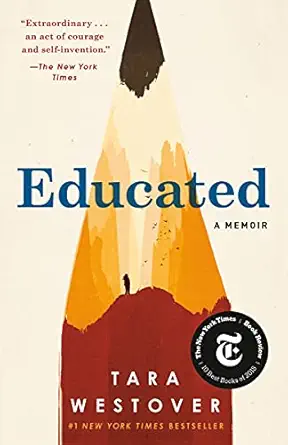
 Book Title: Educated
Author: Tara Westover
Genre: Memoir
Publisher: Random House
Publication Date: 2018
Review Type: Editorial Review
Reviewer: Johan Pavel
🪶 Review Summary
Educated is a memoir that examines the tension between family, belief, and self-determination, tracing one woman’s path from isolation to intellectual and personal independence.
Johan Pavel’s review considers the book’s narrative control, its emotional restraint, and the experience it offers readers engaging with questions of identity and transformation.
✍️ Full Review
Memoir often relies on revelation—on the gradual uncovering of events that reshape how a life is understood.
Educated approaches this differently.
From the outset, Tara Westover establishes a world defined by separation: from formal education, from institutional structures, and, in many ways, from broader society. What follows is not a sudden departure from that world, but a gradual, often conflicted movement away from it.
 The narrative unfolds with notable control.
Westover does not present her story with overt judgment or retrospective certainty. Instead, she allows events to stand largely on their own, resisting the impulse to interpret them for the reader. This restraint is one of the book’s defining strengths. It creates space for the reader to engage with the material without being directed toward a single emotional response.
The result is a reading experience that is both immersive and, at times, unsettling.
The memoir’s central tension lies in the relationship between loyalty and autonomy. As Westover gains access to education—first informally, then through formal institutions—she is confronted with a growing divergence between the framework in which she was raised and the one she is beginning to understand.
This divergence is not resolved quickly, nor is it presented as easily resolved.
What the book captures with particular clarity is the cost of that divergence. Education, in this context, is not merely the acquisition of knowledge. It is a process that reconfigures identity, often at the expense of existing relationships. The progression from one state to another is marked not by triumph, but by ambiguity.
There are moments where the narrative risks becoming repetitive, particularly as certain patterns of conflict re-emerge. However, this repetition also reflects the reality of the experience being described. Change, especially of this magnitude, rarely follows a linear path.
Westover’s prose remains consistent throughout—clear, direct, and unadorned. This stylistic choice reinforces the memoir’s tone. It avoids dramatization, allowing the weight of events to emerge through accumulation rather than emphasis.
For some readers, the lack of overt reflection may feel limiting. The memoir does not frequently pause to articulate broader conclusions about its themes. Instead, it presents a sequence of experiences that gradually reveal their significance.
This approach aligns with the book’s central idea: that understanding is not immediate. It is developed over time, often in retrospect.
⭐ Notable Strengths
• Controlled and disciplined narrative voice
• Emotional restraint that allows events to speak for themselves
• Clear depiction of identity shaped through education and separation
👥 Considerations for Readers
This book may especially appeal to readers who enjoy:
• Memoirs focused on personal transformation
• Narratives that explore identity, belief, and independence
• Stories that unfold through experience rather than interpretation
Readers seeking a more overtly reflective or analytically framed memoir may find the narrative intentionally understated.
🧭 Final Assessment
Educated offers a measured and compelling account of personal transformation shaped by conflict, distance, and the gradual acquisition of perspective. It is a particularly strong work for readers interested in how identity evolves under pressure, and how understanding often comes at a cost.
📌 Disclosure
This review reflects Johan Pavel’s independent editorial opinion. Receipt of a review copy does not guarantee a positive review.