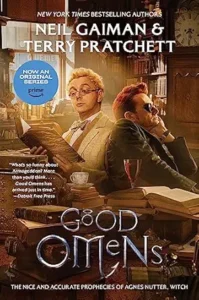
 Book Title: Good Omens
Authors: Neil Gaiman & Terry Pratchett
Genre: Fantasy / Satire / Humor
Publisher: Workman Publishing
Publication Date: 1990
Review Type: Editorial Review
Reviewer: Johan Pavel
🪶 Review Summary
Good Omens is a satirical fantasy that blends humor, absurdity, and philosophical observation, presenting the end of the world as both inevitable and negotiable.
Johan Pavel’s review considers the novel’s tonal balance, its collaborative voice, and the experience it offers readers drawn to humor that reflects rather than obscures its underlying ideas.
✍️ Full Review
There are stories that approach large ideas with seriousness, and others that approach them indirectly.
Good Omens does so through humor.
Neil Gaiman and Terry Pratchett construct a narrative centered on the impending apocalypse, then proceed to treat it as a series of manageable inconveniences. The premise is expansive—cosmic forces, prophetic inevitability, the end of human history—yet the execution remains grounded in the particular.
The result is a consistent tension between scale and detail.
The novel moves across multiple perspectives, each contributing to the broader scenario while maintaining its own tone. Angels, demons, and humans are presented with a shared sense of familiarity, their distinctions less significant than their habits, preferences, and misunderstandings.
This flattening of hierarchy is central to the book’s effect.
Rather than emphasizing difference, the narrative highlights similarity. The agents of cosmic order and chaos are shaped by routines, attachments, and a degree of inertia that mirrors the human characters they observe. This alignment allows the novel to examine large themes—good, evil, fate—through smaller, more accessible behaviors.
The humor operates on several levels.
At its most immediate, it is situational, arising from mismatched expectations and improbable circumstances. Beneath this, it functions as commentary. The novel does not reject its themes; it reframes them, suggesting that the systems governing existence may be less rigid—and more negotiable—than assumed.
The pacing reflects this layered approach.
The narrative progresses through a series of interwoven threads, each advancing at its own rate. While this creates variety, it also introduces moments where the structure feels diffuse. Certain storylines carry more weight than others, and the transitions between them can interrupt momentum.
However, the novel’s cohesion is not dependent on strict alignment.
Its unity emerges from tone rather than structure. The voice—shaped by the collaboration of Neil Gaiman and Terry Pratchett—remains consistent, balancing wit with observation. The humor rarely becomes purely decorative; it continues to reflect the underlying ideas.
For some readers, this approach may feel uneven.
The narrative does not build toward a single, concentrated climax in the traditional sense. Instead, it accumulates moments, allowing resolution to emerge through convergence rather than escalation. Readers expecting a tightly focused arc may find the progression less direct.
Yet this diffusion aligns with the novel’s perspective.
Good Omens is less concerned with the inevitability of events than with the possibility of alteration. Its humor is not merely entertainment; it is a means of examining how systems—cosmic or otherwise—might be influenced by those operating within them.
⭐ Notable Strengths
• Effective integration of humor with thematic exploration
• Consistent and distinctive narrative voice across multiple perspectives
• Creative reframing of large concepts through accessible situations
👥 Considerations for Readers
This book may especially appeal to readers who enjoy:
• Satirical and humorous takes on philosophical or theological themes
• Multi-perspective narratives with tonal variety
• Fantasy that prioritizes wit and observation over spectacle
Readers seeking a tightly structured plot or a singular narrative focus may find the story more expansive than directed.
🧭 Final Assessment
Good Omens offers a thoughtful and often understated exploration of large ideas through humor and collaboration. It is particularly well-suited for readers who value wit as a means of engaging with complexity and who are comfortable with narratives that favor tone over strict structure.
📌 Disclosure
This review reflects Johan Pavel’s independent editorial opinion. Receipt of a review copy does not guarantee a positive review.