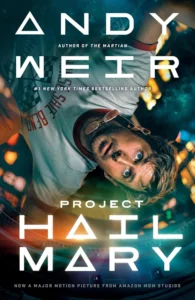
 Book Title: Project Hail Mary
Author: Andy Weir
Genre: Science Fiction
Publisher: Ballantine Books
Publication Date: 2021
Review Type: Editorial Review
Reviewer: Johan Pavel
🪶 Review Summary
Project Hail Mary is a concept-driven science fiction novel that blends problem-solving narrative with character-focused storytelling, presenting high-stakes science through an accessible and engaging structure.
Johan Pavel’s review considers the novel’s pacing, its reliance on scientific logic, and the experience it offers readers drawn to both ideas and momentum.
✍️ Full Review
There is a particular kind of satisfaction that comes from watching a problem unfold—and then, step by step, resolve.
Project Hail Mary is built almost entirely on that satisfaction.
The novel follows Ryland Grace, a scientist who awakens alone on a spacecraft with no memory of how he arrived there, tasked—eventually—with solving a crisis that threatens life on Earth. From this premise, Andy Weir constructs a narrative that alternates between discovery and explanation, steadily revealing both the stakes and the path toward resolution.
The structure is deliberate.
Rather than relying on traditional suspense, the novel generates momentum through a sequence of problems and solutions. Each challenge is introduced with clarity, explored through scientific reasoning, and resolved through incremental progress. This approach gives the book a rhythm that is both predictable and engaging.
For many readers, this is the central appeal.
Weir demonstrates a clear ability to translate complex scientific concepts into readable, often compelling sequences. The explanations are detailed enough to feel grounded, yet accessible enough to maintain narrative flow. The reader is not simply observing the problem-solving process—they are invited into it.
This invitation creates a sense of participation that distinguishes the book from more passive forms of storytelling.
At the same time, the novel’s reliance on explanation shapes its tone. Dialogue and internal monologue frequently serve as vehicles for clarifying scientific principles. While this reinforces understanding, it occasionally interrupts the narrative’s emotional continuity. Moments that might otherwise deepen character are sometimes redirected toward explanation.
The result is a balance that leans toward intellect over introspection.
That said, the novel is not without emotional dimension. As Grace’s situation becomes clearer, the stakes shift from abstract survival to something more personal. The relationships that develop—particularly those that emerge under unusual circumstances—introduce moments of genuine connection, even within a highly structured narrative.
These moments are not the primary focus, but they are effective when they appear.
The pacing remains consistent throughout. The novel rarely lingers, moving steadily from one challenge to the next. Readers seeking rapid progression will find this approach satisfying. Those looking for extended reflection or thematic ambiguity may find the experience more mechanical.
Yet this mechanical quality is also part of the book’s identity.
Project Hail Mary is not attempting to obscure its design. It is a novel about solving problems, and it presents that process with clarity and confidence.
⭐ Notable Strengths
• Engaging problem-solving structure that drives the narrative
• Clear and accessible presentation of scientific concepts
• Consistent pacing that maintains reader momentum
👥 Considerations for Readers
This book may especially appeal to readers who enjoy:
• Science-driven storytelling
• Logical, step-by-step problem solving
• Fast-paced narratives with clear progression
Readers seeking deeply introspective character studies or subtle thematic ambiguity may find the emphasis more technical than reflective.
🧭 Final Assessment
Project Hail Mary offers a structured and engaging science fiction experience centered on logic, problem solving, and steady narrative momentum. It is particularly well-suited for readers who value clarity, ingenuity, and forward movement in storytelling.
📌 Disclosure
This review reflects Johan Pavel’s independent editorial opinion. Receipt of a review copy does not guarantee a positive review.