
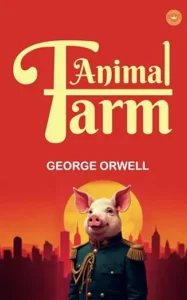
 Book Title: Animal Farm
Author: George Orwell
Genre: Satire / Political Allegory
Publisher: Secker & Warburg
Publication Date: 1945
Review Type: Editorial Review
Reviewer: Johan Pavel
🪶 Review Summary
Animal Farm is a concise and enduring work of political satire that examines power, control, and the gradual erosion of ideals through a deceptively simple narrative.
Johan Pavel’s review considers the novella’s structural precision, its clarity of message, and the reading experience it offers across generations.
✍️ Full Review
Few works achieve what Animal Farm accomplishes with such economy.
In less than two hundred pages, George Orwell constructs a complete political allegory—one that is immediately accessible yet capable of sustaining repeated readings. The premise is straightforward: a group of farm animals overthrow their human owner in pursuit of equality, only to see that vision gradually transformed.
What distinguishes the work is not the novelty of its message, but the discipline of its execution.
Orwell does not obscure his intent. The parallels between the narrative and historical events are clear, and the trajectory of the story is largely predictable. Yet this predictability does not weaken the work. Instead, it reinforces its central concern: that the mechanisms of power often operate in ways that are both visible and ignored.
The structure of the novella is notably precise. Each stage of the animals’ revolution is marked by incremental shifts—small adjustments in language, policy, and memory that accumulate into something irreversible. The famous transformation of the Seven Commandments is not abrupt. It is gradual, almost procedural.
This is where the work is most effective.
Rather than presenting corruption as a singular act, Orwell presents it as a process. The pigs do not seize power in a moment of overt betrayal. They assume it through a series of decisions that, taken individually, appear reasonable or necessary. The result is a system that mirrors the one it replaced, while maintaining the language of its original ideals.
The simplicity of the prose serves this structure well. The language is direct, almost restrained, allowing the reader to focus on the progression of events rather than the style in which they are delivered. This clarity ensures that the work remains accessible, even to those encountering it for the first time.
At the same time, this directness limits ambiguity.
Readers seeking layered interpretation or subtle thematic variation may find the allegory narrowly defined. The characters function primarily as representatives of ideas rather than as fully developed individuals. This is not a flaw, but a choice aligned with the book’s purpose.
Animal Farm is not concerned with character depth. It is concerned with systemic behavior.
What allows the novella to endure is its relevance. While rooted in a specific historical context, its observations extend beyond that origin. The patterns it describes—control of information, revision of history, consolidation of authority—are not confined to a single time or place.
They repeat.
Ultimately, Animal Farm succeeds because it refuses to complicate what it seeks to reveal. It presents power as something that evolves quietly, often under the guise of necessity, and leaves the reader to consider how easily such evolution can be accepted.
⭐ Notable Strengths
• Precise and disciplined narrative structure
• Clear and enduring allegorical framework
• Effective use of simplicity to reinforce complex ideas
👥 Considerations for Readers
This book may especially appeal to readers who enjoy:
• Political and social satire
• Allegorical storytelling with clear thematic intent
• Concise works that invite reflection beyond the page
Readers looking for character-driven narratives or interpretive ambiguity may find the focus more structural than personal.
🧭 Final Assessment
Animal Farm remains a disciplined and highly effective work of satire. Its clarity, structure, and thematic consistency make it a lasting reference point for readers interested in power, language, and the quiet transformation of ideals.
📌 Disclosure
This review reflects Johan Pavel’s independent editorial opinion. Receipt of a review copy does not guarantee a positive review.