
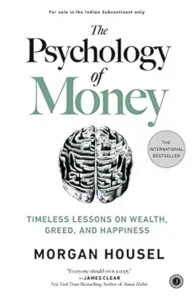
 Book Title: The Psychology of Money
Author: Morgan Housel
Genre: Personal Finance / Behavioral Economics
Publisher: Harriman House
Publication Date: 2020
Review Type: Editorial Review
Reviewer: Johan Pavel
🪶 Review Summary
The Psychology of Money is a collection of concise essays that examine how behavior, rather than knowledge alone, shapes financial outcomes.
Johan Pavel’s review considers the book’s narrative structure, its emphasis on perspective over prescription, and the experience it offers readers seeking a more reflective approach to financial decision-making.
✍️ Full Review
Many books on money begin with instruction.
The Psychology of Money begins with observation.
Morgan Housel does not attempt to construct a comprehensive system of financial rules. Instead, he presents a series of short, interconnected essays, each exploring how people think about money, risk, wealth, and success. The structure is modular, allowing readers to engage with individual ideas without requiring strict progression.
This structure is intentional.
By separating concepts into discrete reflections, Housel avoids the expectation of a single, unified theory. The book does not argue that there is one correct approach to managing money. Rather, it suggests that financial outcomes are often shaped by personal experience, context, and behavior—factors that do not lend themselves easily to universal solutions.
This emphasis on behavior is the book’s central strength.
Housel repeatedly returns to the idea that financial success is less about intelligence and more about consistency, patience, and perspective. Concepts such as compounding, risk tolerance, and long-term thinking are presented not as technical principles, but as habits of mind.
The writing reflects this approach.
The prose is clear and direct, with a conversational tone that supports accessibility. Examples are drawn from both historical figures and everyday scenarios, reinforcing the idea that financial behavior is broadly human rather than narrowly technical. The reader is not asked to master complex models, but to reconsider assumptions.
At times, this accessibility limits depth.
Readers with a background in finance or economics may find the analysis familiar. The book does not engage deeply with quantitative frameworks or detailed strategy. Its focus remains on interpretation rather than instruction. For some, this may feel insufficient.
However, the book does not position itself as a technical manual.
Its purpose is to shift perspective. In this, it is largely effective. By framing money as a domain influenced by emotion, experience, and narrative, Housel broadens the conversation beyond calculation. He suggests that understanding one’s own behavior may be more valuable than acquiring additional information.
This reframing is consistent throughout.
The essays build toward a general conclusion rather than a specific directive: that financial decisions are personal, shaped by circumstances that differ from one individual to another. The absence of rigid prescriptions reinforces this idea.
The pacing supports engagement.
Each chapter is brief, allowing the reader to pause, reflect, and return. This format makes the book approachable, though it also creates a degree of repetition. Certain themes—patience, humility, long-term thinking—recur in multiple forms.
This repetition is not accidental.
It reflects the nature of the subject. Behavioral patterns are rarely internalized through a single exposure. The book’s structure mirrors the process it describes.
⭐ Notable Strengths
• Clear focus on behavior rather than technical complexity
• Accessible essay format that supports flexible reading
• Consistent emphasis on perspective and long-term thinking
👥 Considerations for Readers
This book may especially appeal to readers who enjoy:
• Reflective approaches to personal finance
• Narrative-driven explanations of financial behavior
• Concepts that emphasize mindset over strategy
Readers seeking detailed financial tactics or advanced analysis may find the content more conceptual than technical.
🧭 Final Assessment
The Psychology of Money offers a measured and accessible exploration of how people think about wealth, risk, and decision-making. It is particularly well-suited for readers interested in developing a more thoughtful and sustainable perspective on financial behavior.
📌 Disclosure
This review reflects Johan Pavel’s independent editorial opinion. Receipt of a review copy does not guarantee a positive review.